The Spare Chair Is Not Just Extra Seating
A spare chair can make a home more adaptable without fixing every room in place. Learn how to choose, position, and move one with purpose.
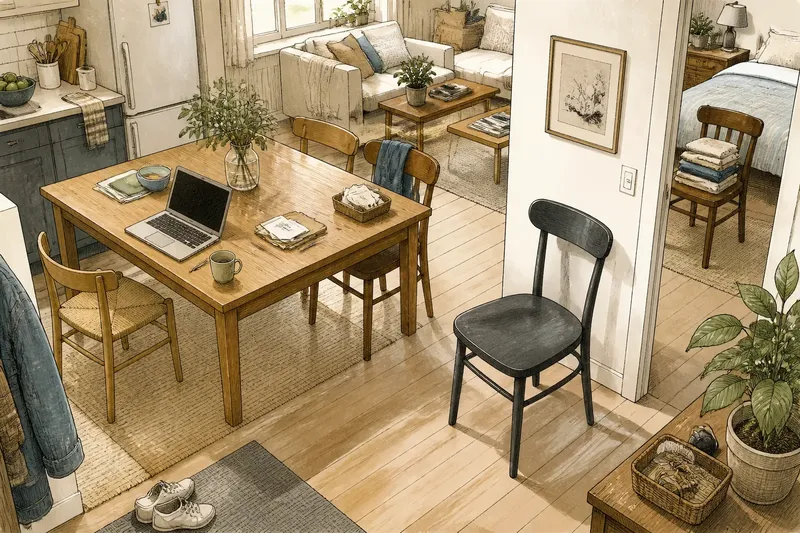
Where should a spare chair go when the dining table doubles as a work surface and the bedroom corner collects laundry? A movable chair can make those shifts easier without making any room permanent.
The useful question is not where the chair belongs forever, but what job it can take on next. Its value depends on whether it helps with a real task and remains easy to move out of the way.
What jobs can one chair actually do?
Start with activities that already happen at home rather than inventing new ones to justify the chair. It might provide a place to sit while putting on shoes, hold a folded blanket beside the sofa, or give someone a seat at the kitchen table when the usual arrangement is occupied.
Those uses can overlap, but not all at once. A chair that supports a brief task in one room may be more useful than a second permanent seat elsewhere. Notice where people pause, wait, or set something down; those small interruptions point toward practical uses.
Keep the list modest. If the chair is expected to function as a desk seat, step stool, coat rack, bedside table, and dining chair, it has been assigned jobs that may conflict. A chair is versatile, not a small department store.
Which chair is easy to move?
Mobility depends on more than weight. A broad back may be awkward through a narrow doorway, while light legs may catch on rugs. Consider the route the chair will travel, including turns around a table and the space beside a sofa.
Check how the chair meets the floor. Felt pads may help protect hard flooring and reduce scraping, while a rug can make a chair harder to shift if its feet catch at the edge. The aim is a chair that moves without ceremony, not one that needs its own relocation plan.
Material also affects where a chair feels at home. Wood, metal, molded plastic, and upholstered seats differ in visual weight and care needs. A simple finish often travels more easily between rooms than a color or fabric that makes sense in only one corner.
Where should it wait between uses?
A movable chair still needs a resting place. Choose a spot that does not block a doorway, narrow a walking route, or invite bags and clothes to accumulate. The edge of a dining area, a clear wall near the entry, or a bedroom corner may work, depending on household traffic.
Look at the chair from the doorway and from the places where people sit. If it seems in the way from both angles, its default position may be wrong. A good waiting spot is visible enough to invite use but quiet enough not to dominate the room.
Keep the immediate area clear. A chair wedged behind a plant or pinned between a cabinet and radiator may technically be available, but retrieving it will feel like a chore. If moving it requires several adjustments, it is less movable in practice.
How can a chair change a room without fixing it?
Furniture suggests where an activity can happen. Turn a chair toward a window to make a place to read; set it beside a table to make room for a guest or a short task. Move it away afterward and the floor opens up again without rearranging the whole room.
Say a household has a dining table that is clear at breakfast but used for sorting mail later. A spare chair starts against the wall. Someone moves it beside the table, sits while sorting the mail, then returns it to the wall; the observable result is a usable seat during the task and a clearer table area afterward.
That small adjustment can be more comfortable than assigning each activity a fixed zone. It lets a room respond to changing company, energy, or daily tasks without requiring a permanent new arrangement.
What should you check before moving it?
A chair can fit physically and still be awkward or unsuitable for the task. Check the new spot before settling it there:
- Walking route: If people can pass without stepping around the chair, keep that position; if not, move it outside the route.
- Seat and surface: If the chair works comfortably beside the table or desk, use it there; if not, choose a different seat or task.
- Floor contact: If the feet sit stably and do not snag, proceed; if they scrape or catch, add suitable floor pads or choose another spot.
- Light and reach: If the light and needed items are accessible for reading or work, use the chair there; if not, move it nearer a lamp or supplies, or pick another task.
- Nearby objects: If the chair clears lamps, cabinets, and cords, keep the route; if not, shift it away from them.
- Return path: If there is a clear place to put the chair back, use it; if not, choose a different resting spot before starting.
These are ordinary fit checks, not a reason to overthink every move. For weight limits, care requirements, floor protection, or suitability for a particular use, follow the manufacturer’s instructions and relevant household rules.
Which uses tend to work best?
A movable chair is especially helpful for activities that need a seat briefly or unpredictably. It can join the dining table when an extra person arrives, sit by the entry while someone handles shoes, or provide a perch near a window. In each case, it helps for a while and can leave afterward.
It may also support a small change in how a room is used. Pulled beside a bed, it can offer a place to sit while folding clothes; placed near a shelf, it can support a pause to sort or read. Keep the chair stable and suited to the activity rather than treating it as a ladder or substitute for purpose-built equipment.
What is not worth the effort is shuffling the chair repeatedly to stage a perfect-looking room. If it is useful where it stands, let it stay until a real need arises. Flexibility is an option, not a household performance.
When should it stop moving?
Some chairs eventually settle into one role because that is where they are needed most. If a chair regularly serves the same person or task, keeping it there may be more sensible than preserving mobility for its own sake. A flexible layout should respond to use, not enforce constant rearrangement.
Notice whether the current location creates friction. Perhaps the chair blocks a cabinet, gets buried under clothes, or is rarely used where it waits. Try a different resting spot or assign it a clearer task. If no location makes it useful, the chair may simply be extra seating after all.
What do people ask about a spare chair?
Where should a spare chair go in a small room?
Keep it near the room’s edge or against a wall, outside the main walking route. A spot that allows easy retrieval is more practical than a hidden corner that requires moving other furniture.
Can a spare chair work in more than one room?
Yes, if it can pass through the route between those rooms and suits the tasks in each. A chair that is awkward to carry or incompatible with nearby surfaces may be better assigned to one area.
How do you keep a spare chair from becoming a clothes pile?
Give it a visible purpose and keep its resting place clear. If it repeatedly collects clothes, provide a more suitable place for worn or clean garments rather than treating the chair as storage.
Does every room need a chair?
No. A room only needs seating if its activities call for it, and one movable chair can serve more than one area. It works best when it answers a real need without making the rest of the room harder to use.
A spare chair earns its floor space through usefulness, not permanence. Keep its resting spot accessible, move it when a task calls for a seat, and return it when the task ends. The search phrase spare chair flexible home layout describes the point: one seat can help a home change use without turning every change into a renovation.