A Drawer or an Open Shelf for Things Used in Passing?
A drawer or open shelf for small everyday items? Compare access, visual clutter, and memory to choose a home that suits what you reach for in passing.
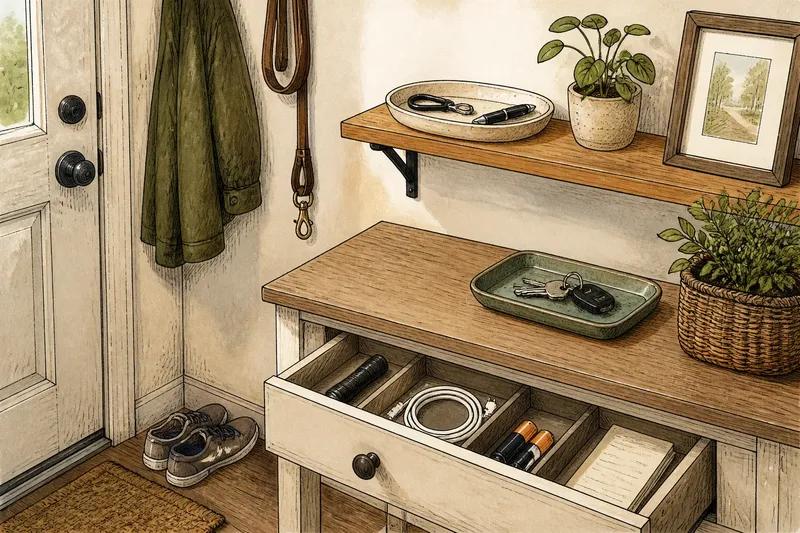
Should the spare keys, pen, lip balm, and charging cable live in a drawer or on an open shelf? A drawer or open shelf for small everyday items changes not just how quickly you reach them, but whether you notice them at all. Imagine a household trying to make one awkward corner by the front door useful without turning it into a display of pocket debris.
In this invented situation, Mara and Lee share a narrow entryway. They keep losing track of a small flashlight, a dog-walking clip, and the pen used to mark delivery notes. The items are used often, but not on the same schedule: the pen may sit untouched for days, while the clip leaves the house most mornings.
They start with a shallow drawer in the console table. The objects disappear from view, which makes the entry look calmer. But the clip gets buried under receipts, and the flashlight is no easier to remember than before. The drawer has solved the visual problem while quietly making the access problem worse.
What belongs within reach?
Before choosing storage, Mara and Lee consider what “frequently used” means in this corner. An item used while passing through the room has a different claim on visible space from one used regularly but only after opening a cabinet. The useful question is not simply how often something is used; it is whether seeing it at the right moment helps.
The dog-walking clip is tied to leaving the house. If it is hidden, someone must remember to open the drawer before going out. The pen is needed only when a delivery arrives, so it can remain accessible without occupying prime visual attention all day. The flashlight is an occasional backup, not a passing-use item merely because it is useful.
They sort the three objects by the action that prompts them: leaving, receiving a package, and responding to a power outage. That small distinction prevents “useful” from becoming a generous excuse for storing everything near the door.
Does a drawer make the corner calmer?
A drawer offers a simple bargain: less visible clutter in exchange for an extra action. That bargain works when the contents are easy to retrieve and the drawer is not asked to hold unrelated odds and ends. A small tray or divider can keep a pen from tangling with a cable, but no organizer can make an overfilled drawer intuitive.
For Mara and Lee, the drawer’s closed front reduces the visual noise of the entry. Its disadvantage appears when someone is carrying groceries, managing the dog, or simply moving through on the way out. Opening a drawer is a minor task; having to search inside it is the part that turns a minor task into a recurring nuisance.
They also notice that a drawer can hide the very evidence that an item needs attention. A charging cable left inside may be unavailable when the device is low, and a pen that has wandered behind other things may as well be elsewhere. Closed storage does not erase clutter so much as move it out of sight.
When does an open shelf help you remember?
An open shelf makes an item visible before the moment of use. That can help when the object serves as a prompt: the dog-walking clip is easier to remember if it is in view beside the door. Visibility also makes it obvious when something has not been returned, which is useful information even if it is not especially decorative.
The cost is that every visible object becomes part of the room’s visual field. A shelf holding a clip, pen, loose change, two mailers, and a cable can look untidy even when each item has a defensible reason to be there. A small container limits the spread, though it may also conceal the contents and weaken the shelf’s reminder effect.
Mara and Lee try a narrow wall shelf with one open dish for the clip and pen. The flashlight moves to the drawer, where it is protected from casual displacement but not needed as a daily prompt. The shelf now shows two objects with clear jobs, rather than a collection of items that happened to land together.
Which storage choice fits each item?
Should keys go in a drawer or on a shelf?
Keys used on most departures are easier to remember when they have a visible, consistent landing place near the exit. If loose keys make the area feel cluttered, a single hook or small dish can contain them without hiding them in a drawer.
Where should small tools and backup items go?
Items used occasionally, such as a flashlight or spare batteries, usually need a dependable home more than a visible prompt. A labeled drawer compartment can keep them findable without making the entryway look like a supply counter.
Is an open container still visible storage?
Yes, but the rim and walls create a boundary, so it can gather small items without letting them spread across a shelf. Choose a container shallow enough that its contents remain apparent; a deep box can behave like a drawer with no lid.
What if several people use the same shelf?
Keep shared items in a clearly defined area and avoid assigning the entire surface to one person’s pocket contents. If objects repeatedly migrate, the storage location may be inconvenient, or the household may not agree on what belongs there.
What changed in the entryway?
After the trial, Mara and Lee keep the dog-walking clip on the shelf, place the pen beside it, and put the flashlight in a divided drawer. The observable result they expect is straightforward: the clip is visible when someone heads out, the pen remains easy to grab, and the less-used flashlight is no longer competing for attention.
The point is not that a mixed arrangement is always best. It is that storage can be assigned item by item rather than chosen as a single rule for a whole room. A drawer is not inherently orderly, and an open shelf is not inherently careless. Each can be useful; each can also become a convenient place to postpone deciding.
What is not worth the effort is buying a set of matching bins before knowing which objects deserve visibility. Start with the items that already collect in the area, give each one a plausible home, and notice which are awkward to retrieve or easy to forget. If an object’s role changes, its storage can change with it.
For a drawer or open shelf for small everyday items, let the item’s passing moment make the decision: display what benefits from being seen, and close away what merely needs a reliable address. The best arrangement is often the one that asks for the least remembering without asking the room to show everything.